
SMART FARMING:
Smart Farming: The Future of Agriculture
“Smart Farming” is an emerging concept that refers to managing farms using technologies like IoT, robotics, drones and AI to increase the quantity and quality of products while optimizing the human labor required by production. The Internet of Things (IoT) has provided ways to improve nearly every industry imaginable. In agriculture, IoT has not only provided solutions to often time-consuming and tedious tasks but is totally changing the way we think about agriculture. What exactly is a smart farm, though? Here is a rundown of what smart farming is and how it’s changing agriculture.
What Is a Smart Farm?
Smart farming refers to managing farms using modern Information and communication technologies to increase the quantity and quality of products while optimizing the human labor required.
Among the technologies available for present-day farmers are:
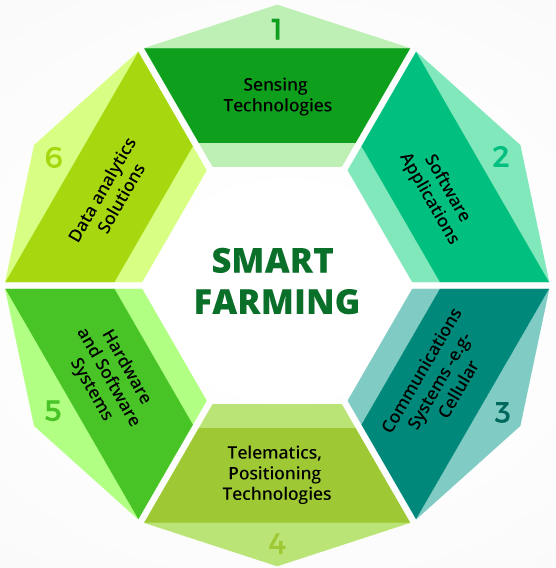
- Sensors: soil, water, light, humidity, temperature management
- Software: specialized software solutions that target specific farm types or applications agnostic IoT platforms
- Connectivity: Cellular, LoRa, NB-IoT, Broadband
- Location: GPS, Satellite
- Robotics: Autonomous tractors, processing facilities
- Data analytics: standalone analytics solutions, data pipelines for downstream solutions
Armed with such tools, farmers can monitor field conditions and make strategic decisions for the whole farm or a single plant without even needing to step foot in the field.
The driving force of smart farming is IoT — connecting machines and sensors integrated on farms to make farming processes data-driven and automated.
The IoT-Based Smart Farming Cycle
The core of IoT is the data you can draw from things and transmit over the internet. To optimize the farming process, IoT devices installed on a farm should collect and process data in a repetitive cycle that enables farmers to react quickly to emerging issues and changes in ambient conditions. Smart farming follows a cycle like this one:
- Observation . Sensors record observational data from the crops, livestock, soil, or atmosphere.
- Diagnostics. The sensor values are fed to a cloud-hosted IoT platform with predefined decision rules and models—also called “business logic”—that ascertain the condition of the examined object and identify any deficiencies or needs.
- Decisions . After issues are revealed, the user, and/or machine learning-driven components of the IoT platform determine whether location-specific treatment is necessary and if so, which.
- Action . After end-user evaluation and action, the cycle repeats from the beginning.
IoT Solutions to Agricultural Problems
Many believe that IoT can add value to all areas of farming, from growing crops to forestry. While there are several ways that IoT can improve farming, two of the major ways IoT can revolutionize agriculture are precision farming and farming automation.
Precision Farming
Precision farming, or precision agriculture, is an umbrella concept for IoT-based approaches that make farming more controlled and accurate. In simple words, plants and cattle get precisely the treatment they need, determined by machines with superhuman accuracy. The biggest difference from the classical approach is that precision farming allows decisions to be made per square meter or even per plant/animal rather than for a field.
By precisely measuring variations within a field, farmers can boost the effectiveness of pesticides and fertilizers, or use them selectively.
Automation in Smart Vertical Farms
Traditional greenhouses control the environmental parameters through manual intervention or a proportional control mechanism, which often results in production loss, energy loss, and increased labor cost.
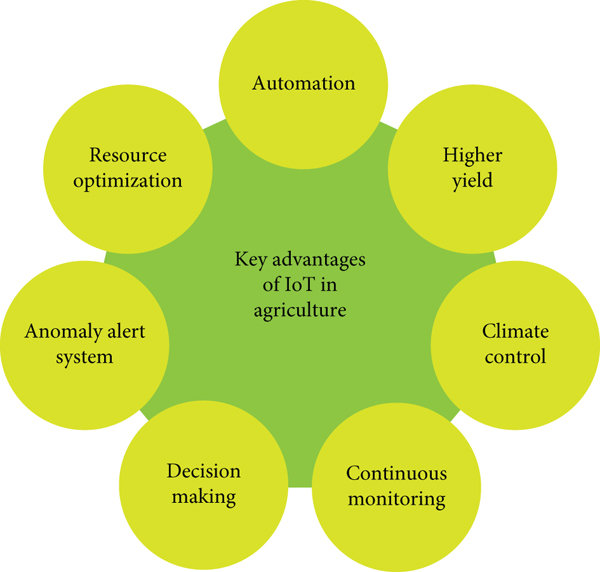
IoT-driven smart Vertical Farms can intelligently monitor as well as control the climate, eliminating the need for manual intervention. Various sensors are deployed to measure the environmental parameters according to the specific requirements of the crop. That data is stored in a cloud-based platform for further processing and control with minimal manual intervention.
Urban Farming - Part of 4.0 Agriculture
Agriculture 4.0 incorporates the evolution of precision farming and refers to all actions that are carried out in agriculture based on a, precise and accurate analysis of data and information collected and transmitted through advanced tools and technology.
This refers to the tools and strategies that enable the synergistic use of a range of digital 4.0 technologies, in turn allowing the automatic collection, integration and analysis of data collected from the field, from sensors, or from other third-party sources.
The aim of these technologies is to offer the most extensive and precise support to farmers in the decision-making process related to their activity and the relationship with other parties in the supply chain.
The ultimate goal is to increase economic, environmental, and social sustainability – as well as profitability – of agricultural processes.
Agriculture 4.0 refers to the use of Internet of Things (IoT), Big Data, Artificial Intelligence and Robotics to extend, speed up, and increase the efficiency of activities that affect the entire production chain.
Adopting 4.0 solutions in agriculture means:
- Avoiding unnecessary waste by calculating the exact water requirements of the crop or detecting in advance the onset of certain plant diseases or pests
- Having greater control over cost and being able to plan all stages of cultivation, sowing and harvesting with a great deal of precision, saving both time and money
- Improving the traceability of the supply chain can result in a short supply chain that is capable of producing high quality food in a sustainable manner with little margin for error.